Surface science
Different phenomena can modify the appearance or behavior of a stainless steel surface. Understanding them allows for the selection of the right strategy.
Stainless steel owes its corrosion resistance to an extremely thin passive layer, rich in chromium oxides, which forms naturally on its surface.
The challenges
01
Identifying the role of the passive layer in the material’s resistance to its environment.
02
Do not confuse corrosion, rouging, deposit, microbiological contamination, and biofilm.
03
Linking the observation to the material, the installation, and the operating conditions before treating.
Understand
This protection can evolve under the influence of manufacturing, surface finish, treatments, the environment, or operating conditions.
Corrosion, rouging, and biofilm do not describe the same phenomenon. Distinguishing them is essential to understand the actual state of the surface and avoid unsuitable treatment.
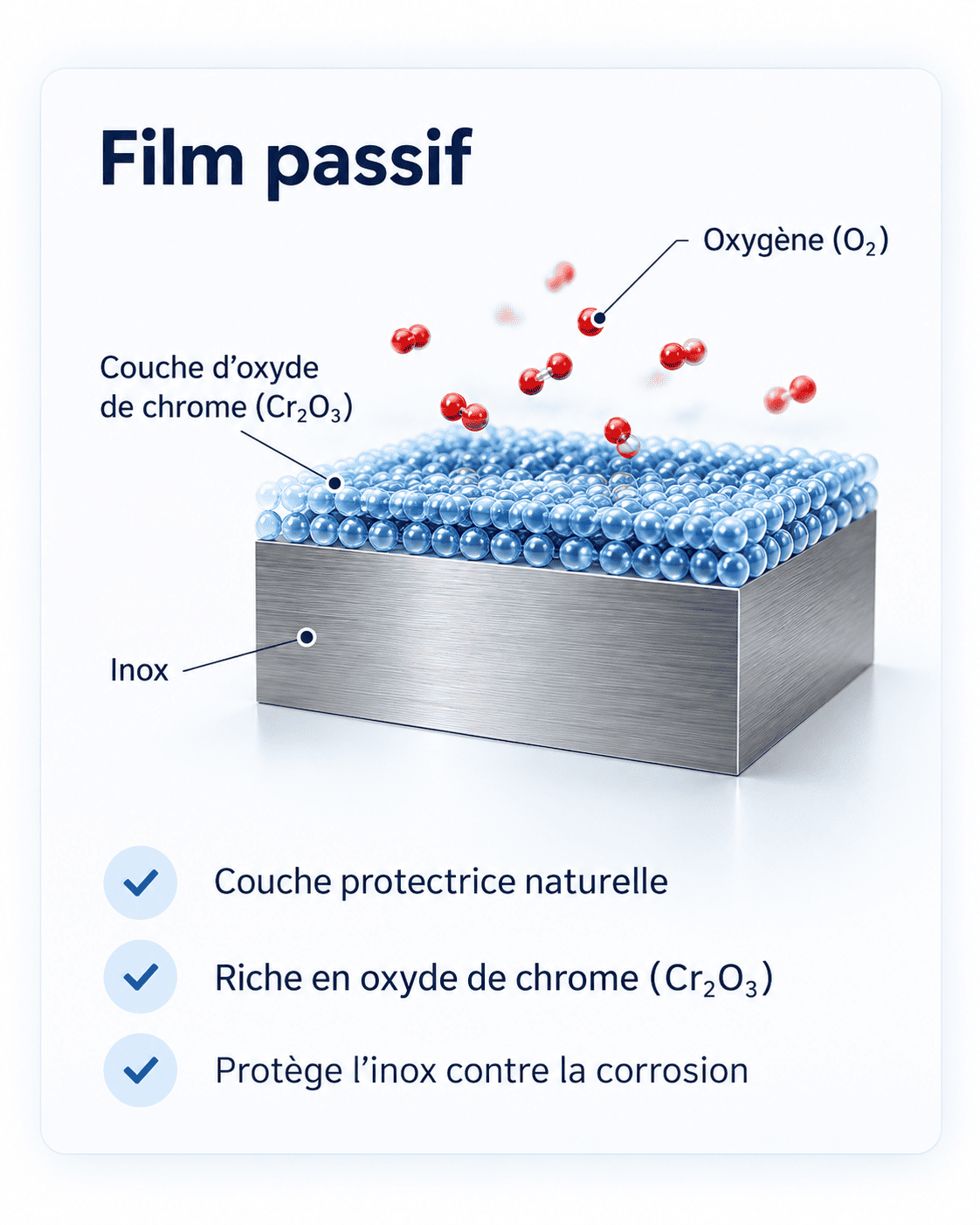
Stainless steel contains chromium which, under appropriate conditions, allows the spontaneous formation of an extremely thin passive layer rich in chromium oxides.
This layer constitutes a protective barrier that contributes to the corrosion resistance of stainless steel.
Its behavior depends, however, on many parameters: stainless steel grade, surface finish, manufacturing, contamination, treatments undergone, and operating conditions.
Passivity is therefore not a coating added to the metal: it corresponds to a protective state of its surface.
Stainless steel is resistant to corrosion, but it is not unalterable.
The chemistry of the medium, the temperature, the presence of certain chemical species such as chlorides, the surface finish, the geometry of the equipment, and the operating conditions can influence the behavior of the passive layer.
When conditions become unfavorable, corrosion phenomena can appear, particularly in a localized manner.
However, a coloration or a visible modification alone does not allow for a conclusion of corrosion.
The observation must always be placed in the context of the material and its environment.
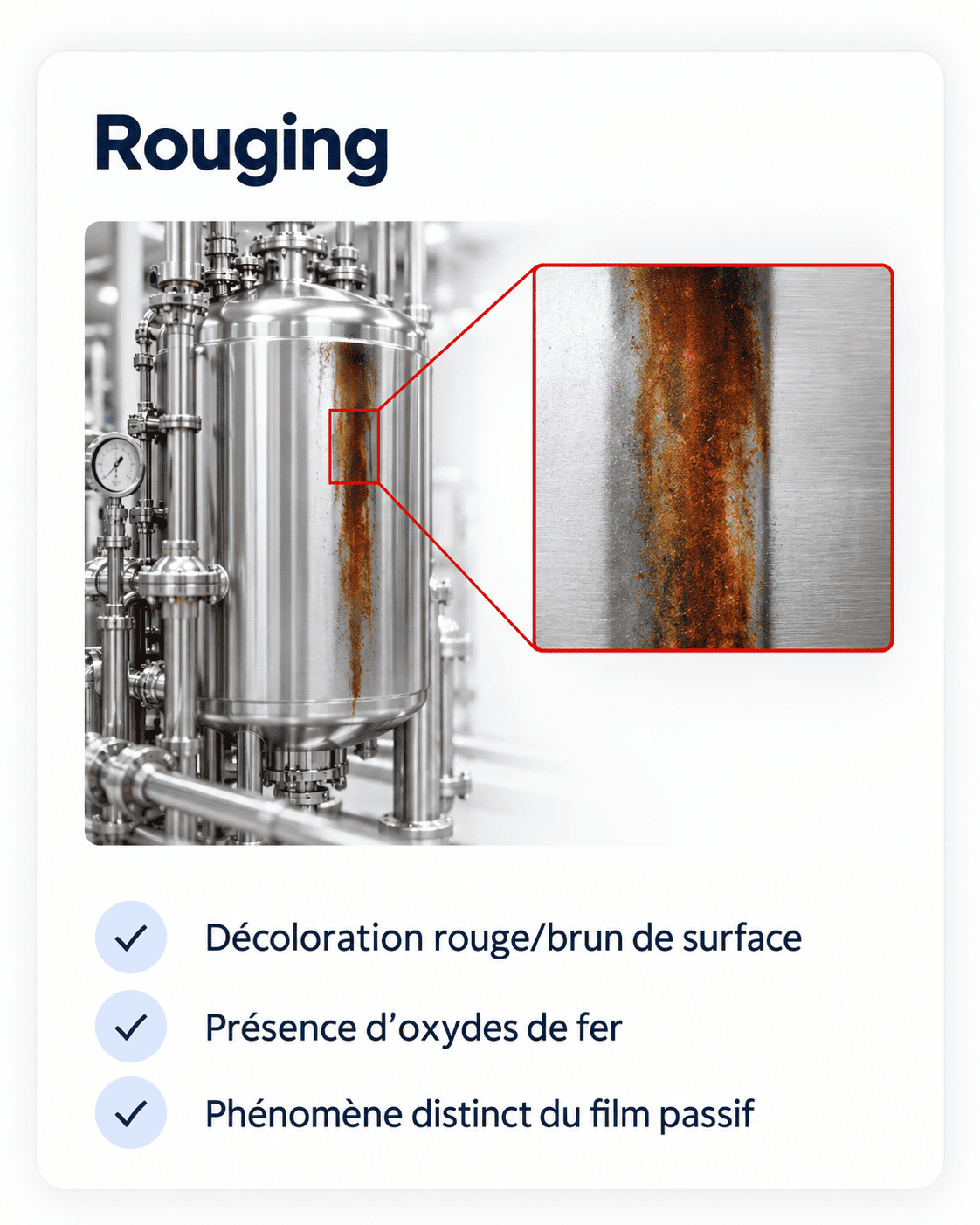
Rouging is a phenomenon encountered particularly on stainless steel equipment and installations in pharmaceutical and high-purity environments.
It corresponds to an evolution or modification of the surface associated with the formation and presence of an iron-enriched oxide layer.
Its appearance, nature, and significance can vary depending on the installation, the initial state of the surface, and the operating conditions.
Rouging should therefore not be interpreted solely based on its color.
Observing the phenomenon, understanding its history and, when necessary, characterizing the surface allow for the orientation of the treatment strategy.
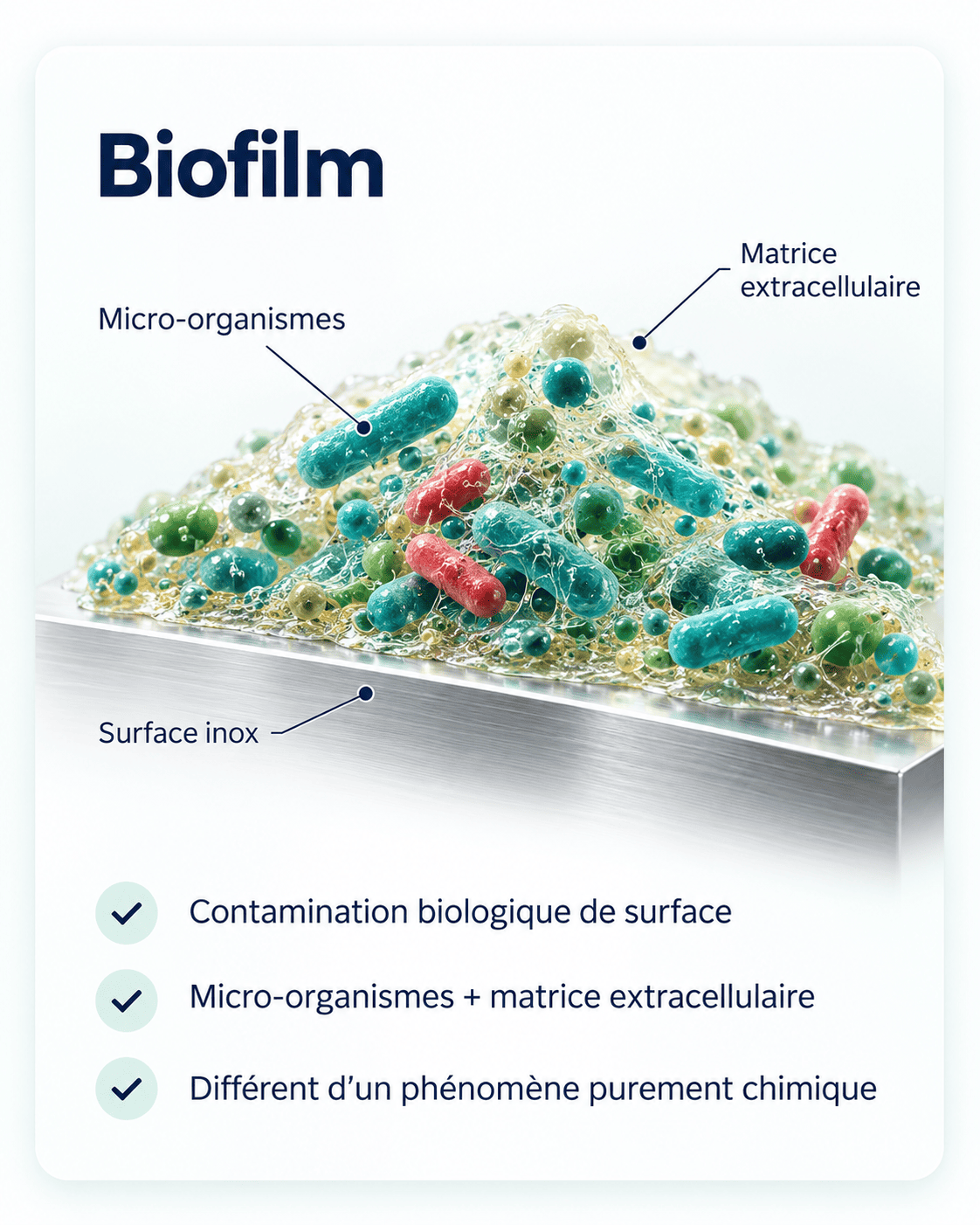
A biofilm is neither corrosion nor rouging.
It consists of an organized community of microorganisms associated with an extracellular matrix adhering to the surface. This structure can notably limit the effectiveness of a standard cleaning or disinfection operation.
Its elimination therefore requires a specific strategy aimed at acting on the matrix and the associated microbiological contamination.
However, recurring microbiological contamination does not, by itself, demonstrate the presence of a biofilm.
Diagnosis and the history of the installation remain essential before defining the strategy.
Our approach
Observe, understand the context, characterize if necessary, and define the strategy.
01
Observe
Identify the appearance, location, and extent of the phenomenon.
02
Understand the context
Cross-reference the observation with the material, the history of the installation, and its operating conditions.
03
Characterize if necessary
Select the relevant measurement and analysis tools to deepen the diagnosis.
04
Define the strategy
Choose the treatment adapted to the actually identified phenomenon and the installation.
The keys to interpretation
We do not treat a color. We restore a surface.
Passive layer — The protection of stainless steel
Extremely thin protective state of the surface, associated notably with the presence of chromium oxides.
Corrosion — An alteration of the material
Electrochemical phenomenon that can appear when conditions become unfavorable for maintaining the protective behavior of the surface.
Rouging — An evolution of the stainless steel surface
Phenomenon associated with an iron-enriched oxide layer, frequently encountered on certain high-purity installations.
Biofilm — An organized microbial community on the surface
Microorganisms associated with an adhering extracellular matrix requiring a specific treatment strategy.
Different phenomena can produce similar visual appearances. A coloration, a deposit, or a modification of the surface state must therefore be interpreted by taking into account the material, the history of the installation, and its operating conditions.
Depending on the issue, observation can be supplemented by roughness measurements, topography characterization, 3D microscopy, or metallographic replicas.
The objective is not to multiply analyses, but to have the necessary information to understand the phenomenon before choosing the chemistry or treatment technology.
Passive layer
Corrosion
Rouging
Biofilm
Technochim expertise
At Technochim, surface science is not dissociated from treatment.
An observation can be compared with the history of the installation, the operating conditions and, when necessary, with measurements and observations carried out in our own laboratory.
Roughness, 3D topography, microscopy, SDR, or metallographic replicas can complete the analysis depending on the problem encountered.
This ability to link what we observe on the surface, what is happening in the installation, and the available technologies for intervention allows for the construction of an adapted strategy rather than systematically applying a predefined treatment.
Diagnose → Define the strategy → Treat → Inspect → Protect
Let’s understand the phenomena observed on your surfaces to choose an adapted strategy.